• Home
  • About
  • Contact
  • IWM Research
BUTTE VISTA FARM

Butte Vista Farm Blog


This blog was developed with support from the Sustainable Agriculture Research and Education (SARE) program, which is funded by the U.S. Department of Agriculture – National Institute of Food and Agriculture (USDA – NIFA). Any opinions, findings, conclusions or recommendations expressed within do not necessarily reflect the view of the SARE program or the U.S. Department of Agriculture. ​USDA is an equal opportunity provider and employer.
--

9/14/2019

0 Comments


Recording Results

We finally had a break in the weather to get some hay harvested. After a number of 12 to 14-hour days, we’ve filled our hay shed, but that hasn’t given us much computer time. Then again, time in the field has given us a chance to think about what we wanted to share in this month’s update. For our August/Mid-September post, we are recapping what we’ve accomplished in each of our IWM areas. In the upcoming post at the end of this month, we will discuss the term “sustainability” and how our IWM operations are fulfilling what have been called the “3 Pillars of Sustainability.”
​
First, our recap…

Chemical IWM

​As we’ve examined and evaluated the effectiveness of various herbicides and application rates in our test plots, all chemicals, except one, appear to have eliminated the chicory plant, as well as all broadleaf plants including clover. Most herbicides also took out the alfalfa. We recently noted, however, that the alfalfa is making a bit of a comeback on a few plots. Clearly, though, in the plots that had Panoramic 2SL (also marketed as Plateau) applied at a rate of 4 ounces per acre, the chicory, along with the alfalfa and clover, has been “sickened” but not killed. 
Picture
We wondered why.

As we were writing our grant proposal, we stated in our project procedures that we would note what worked to raise cultivated chicory and would be cognizant of that when trying to control wild chicory. We wanted to determine if cultivated chicory and wild chicory behave the same. At least when it comes to a certain class of herbicide, the answer is maybe.

In reviewing previous research articles about controlling (and growing) chicory, we recalled that a particular group of chemicals has been determined to be safe to use in plots of cultivated chicory to remove unwanted weeds but not harm the chicory. A 2013 article published by the University of Nebraska, Lincoln, for instance, highlighted the efforts of UNL professor Dr. Robert Wilson (now Emeritus Professor) in growing chicory and noted him remarking, “Early research also showed that the herbicide imazamox was safe to use on chicory…”

A quick search found many sites referencing that imazamox (marketed as the herbicide Raptor) has been recommended in the use of controlling unwanted weeds in wildlife food plots consisting of alfalfa, clover, and chicory. That led us to check into the chemical structure of imazamox (Raptor) to find if any similarities exist between it and Panoramic 2SL (Plateau). See below. The differences between the two are bolded.

The active ingredient in Raptor is 12.1% ammonium salt of imazamox: 2-[4,5-dihydro-4-methyl-4-(1-methylethyl)-5-oxo-1 H-imidazol-2-yl]-5-methoxymethyl-3-pyridinecarboxylic acid. 

The active ingredient in Panoramic 2SL (Plateau) is 23.3% ammonium salt of imazapic: 2-[4,5-dihydro-4-methyl-4-(1-methylethyl) -5-oxo-1 H-imidazol-2-yl]-5-methyl-3-pyridinecarboxylic acid.

The two are almost identical, with the exception of imazamox (Raptor) versus imazapic (Panoramic 2SL) and                    5-methoxymethyl (Raptor) versus 5-methyl (Panoramic 2SL). What’s more, Raptor is labeled for use to control weeds in plantings of chicory. A quick, deeper check into the label for Panoramic 2SL showed it is also to be used to control weeds in plantings of chicory.

Panoramic 2SL (Plateau) didn’t eliminate the chicory in our test plots because it wasn’t supposed to. For someone familiar with herbicides and, especially, someone knowledgeable of the plant physiology of chicory, this would probably be common knowledge. To novices like us, though, this is what could be referred to as an “aha moment.”

The lesson? When using herbicides, you really need to check the labels; in fact, it’s essential to read the labels so you know what you are using and whether you are using it correctly.

An issue we have is trying to control or eliminate unwanted weeds, namely chicory, in our grass/alfalfa fields without causing permanent harm to the alfalfa. We have learned that in multi-species plantings of alfalfa, clover, and chicory, all plants seem to be tolerant of certain types of chemicals. But is alfalfa more tolerant to a higher rate of certain chemicals than chicory is, even though chicory could survive the same chemical at a lower rate? Raptor, for example, lists safe treatments of up to 6 ounces per acre for alfalfa but only 4 ounces per acre for chicory. Could we take advantage of that and use a higher rate of Raptor in heavily chicory-infested grass/alfalfa fields and salvage the alfalfa but eliminate the chicory? Additionally, are there other herbicides that may produce similar results that haven’t even been labeled for alfalfa or chicory? We have already seen some indication of that in the other plots, as we’ve mentioned earlier. 

Many stands of alfalfa in western South Dakota (ours included) are older stands with many plants being 15 to 20 (even more) years old and with deep tap roots. The chicory plants are typically younger, having more recently reproduced from seed or old growth. Research shows that, even if nurtured, chicory lives to five to seven years old. This is still younger, though, than decades’ old growths of alfalfa. Does that give alfalfa an advantage?

This sounds like a potential project for next year.

We talked with Mr. Paul Johnson (South Dakota State University Cooperative Extension Weed Science Coordinator), our expert advisor for the project who is conducting the herbicide trials. We’re not certain about the rates and what types of chemicals might work but we will be planning some trials to see if we can eliminate the chicory from some of our grass/alfalfa fields but retain the alfalfa population. If we could accomplish that, such results would be a huge benefit to producers dealing with this problem.

It goes without saying that our herbicide trials are set for at least two years for specific reasons. One is so we can take into account all we have just mentioned and see what long term effects we observe next year. To finalize this year, we will be cutting the forage from the plots so we can get a better look at the new, ground-level growth next year. Next month, we will provide a full list of chemicals used in the trial and their associated results.

Stay tuned…  

Biological IWM

With regard to biological practices, our weed eating crew has been busy. We turned the boys out onto a small area that had been frequented by cattle last month when they came in for water and lounged around the windbreak for shade. The paddock is just under one acre in size and has been dedicated as somewhat of a “sacrifice area,” a place that is expected to get beaten up grazing wise. The weeds (chicory included) are often abundant because the area receives such heavy animal traffic.

This seemed like the perfect spot to do a monitored trial to determine the effectiveness of using goats to biologically reduce and control the weeds. It may be noted that we had originally intended to put the goats in another area earlier this year, but because of the wet weather (and the fact that the spot was under water for a while), that was not possible. We have been monitoring the regular pastures to see how the goats have grazed and have noted some good information. But this small plot finally offered us the chance to see what happens when goats are confined to a small area.

We knew from previous experience that animals can be trained to target a specific plant, and we hope that next year we will have a chance to do a more intensive grazing trial. But given the circumstances, rotating the goats into a pasture/plot that had been very recently utilized by other livestock (cattle) also provides good research data. This multi-species grazing practice is often recommended by grassland, range, and other grazing experts.

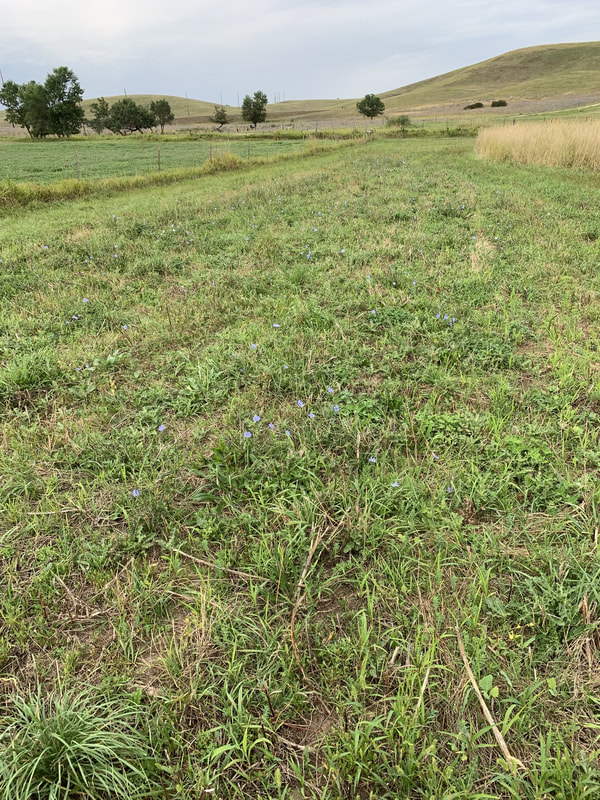
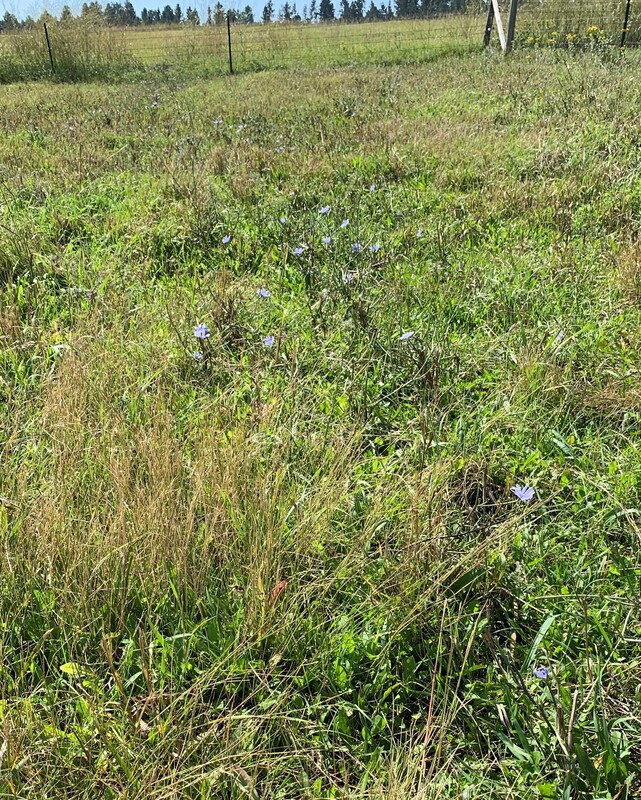
​The boys did not disappoint. As can be seen from the following before and after photos, they made a significantly impact that prevented the chicory from producing seeds. Even though the actual chicory plant still existed after the goats were rotated out of the plot, the number of seed-producing flowers was greatly reduced.   
​One caution: animals may control a plant, but it may take a long time for them to ultimately eliminate it, if ever. As we mentioned in our last blog, anytime you remove livestock for an extended time from an area that has been grazed, you can expect an influx of undesirable plants. Animals will do a good job of controlling things while they are present, but you must have a plan in place if the animals are taken off permanently. Things lurk below the soil surface just waiting for a chance to come alive, even in the best managed areas. This is a good reminder of why it’s important to employ as many of the IWM strategies as possible on your operation. Only one practice does not make a good weed control program!

Mechanical IWM

​Theoretically, consistently removing a plant’s reproductive sources (seed production and the ability of the plant to store nutrients in the roots) by mowing, grazing, or burning should cause the plant to eventually die off. As we have repeatedly mentioned, though, this is not entirely true. Although the repetitive mowing of chicory may keep it somewhat controlled, we still have yet to see proof that it will eliminate the plant. Some people maintain that the lifespan of chicory is two years. However, we have regularly seen new growth (and, presumably, new plants) emerge from old, existing, dying plants. Most living things want to propagate. Chicory is certainly no exception.  
Picture
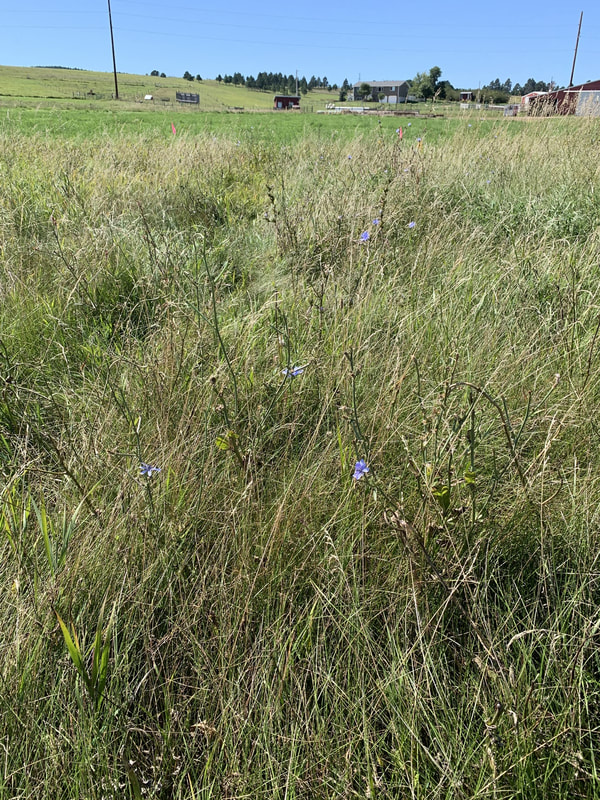
​In our last blog, we mentioned that we would report on test trials of mowing at various heights to discover what, if any, effect those differences would have on the chicory. In a series of plots (each being about one-half acre in size) within a pasture that is currently being grazed by cattle, we mowed one plot at 3”, one at 6”, one at 9”, and one at 12”. The 3”, 6”, and 9” plots did not show much regrowth or development of flowers. However, the 12” plot showed a fair number of flowers reappearing. Granted, this mowing was done in early August when the rate of plant growth was noticeably slower. The cattle were in that area as well and likely consumed some of the grasses, but we didn’t notice much of the chicory eaten so we thought the plants were nearing the end of their growth cycle. 
​Even so, in mid-August, in another pasture with no animals, we mowed the chicory to about 8” in height and checked this same location about three weeks later. We were actually surprised at how this area showed new flowers. In the first week of September, therefore, we chemically treated the area. 
Picture
Another mechanical practice we recently implemented is some hand-pulling of chicory from a grass/alfalfa field located near the county road. In the past, with what we had known and were familiar with, we just accepted the fact that the chemicals we were using to control the chicory in our hay fields would eliminate or, at least, greatly reduce the alfalfa population. In this particular field, we have a very desirable amount of alfalfa and we have been trying hard to keep the chicory from spreading into it. We have been employing a spot-spraying method rather than applying herbicide to the entire field. Still, new plants seem to find their way into the field.
​
Earlier, we harvested the hay before the chicory had flowered so we were comfortable that we could market that cutting of hay. Last week, we noticed that a number of chicory plants were again present and flowering. The second growth of alfalfa was coming nicely so we opted to walk the entire field and hand-pull anything we saw. We salvaged the alfalfa and now, weather permitting, we will have a nice second-cutting hay product to market. Since this is a small field (four acres), hand-pulling was something we could reasonably accomplish, even if it took us a few hours. But could we have done this on 40 acres? Not impossible but improbable. 

Cultural IWM

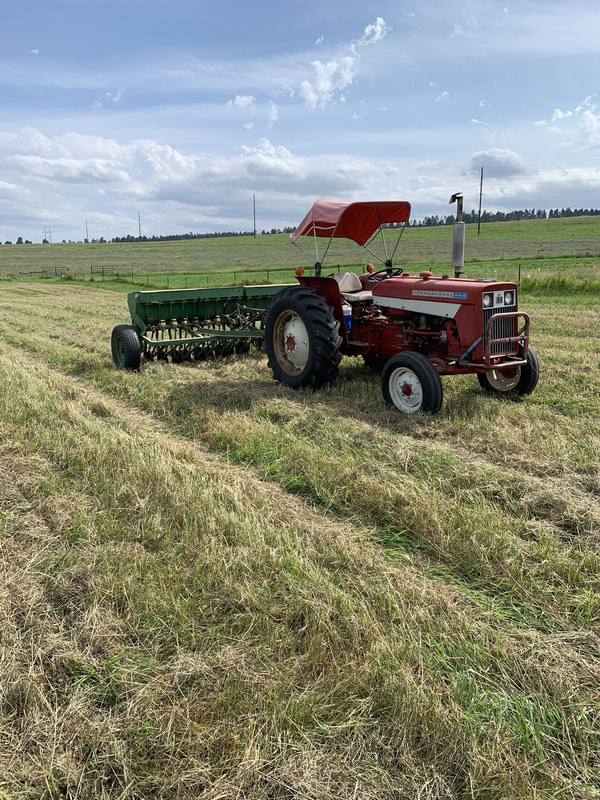
​The main cultural activity that took place this past month was the attempted incorporation of a cover crop in a weed-infested field. Part of the field was treated with a simple 2,4D chemical application (at a 1.7 pints per acre rate) to get the weeds knocked back but retain the grasses. The other part received no chemical treatment. Both sections were mowed to a plant height of about 8” to allow, in theory, the discs of the grain drill to get through the plants and provide seed-soil contact. Because of the small window of opportunity in the weather, the planting had to be done before the recommended 30 days’ period between application of the 2,4D and the planting of the cover crop (which included grasses and broadleaf plant varieties) had passed. We did not have access to a no-till drill so we decided that rather than broadcast the seed into the field, we would use our convention grain drill in a no-till fashion.
Picture
There are times when an idea sounds good but, in short, this was a complete failure! Part of the problem was there was too much plant residue on the ground after mowing and the discs of the conventional drill simply could not cut through to get the seed to the soil. In the end, we should have not done anything at all or waited to use a true no-till drill. At the very least, we didn’t risk the emergence of new weeds by using more aggressive tillage to remove the live plants and work in the remaining residue and then use the conventional drill. Regardless, this was a complete waste of time, fuel, money, and seed. Lesson learned!
​
We would still like to experiment with some cover crops but we will strive to do it using a true no-till system and proper timing of the herbicide application. The chemicals do provide us conventional operators with more options, but we feel planting cover crops could be an option for the organic producer to aid them in reducing weed population and, at the same time, improve soil health. 

Preventative IWM

As in prior years, our primary preventative practice was not marketing the hay harvested from portions of our fields that had an unacceptable amount of chicory. Although we did chemically treat the fields first, for peace of mind we chose not to sell the hay.
​
The other new aspect is that we are making efforts to establish a buffer on our outside borders that will be areas that we can treat with herbicides as needed to keep unwanted weeds from invading further into the fields and pasture in which we have managed to get the noxious weeds under control and even eliminated. Until we develop a chemical alternative that will allow us to retain our alfalfa while treating the chicory and other weeds, it is expected that most of the buffer will either be grass pasture or grass hay only (with the hopeful exception of the four-acre field mentioned earlier). Some fields and areas in our pastures are nearly weed free. If we can keep weeds from invading further onto our property, we can keep the inner fields clean and not have to resort to repeated weed control methods.

Other Happenings

Lastly, we very recently had an opportunity to present our project at a meeting of the South Dakota Weed and Pest Commission, which is comprised of council members appointed by the Governor and non-voting members from several state agencies. This group is the regulating authority for noxious weeds across the entire state. Also present at this meeting were members of the South Dakota Weed and Pest Association, which is the group that represents the South Dakota county weed and pest supervisors. Some members of this same group then came to the farm to actually see the research results we have accomplished on our farm. It was rewarding to share our efforts with these folks.
​
That’s all for our recap. Please stay tuned for the post coming up at the end of this month in which we discuss the term “sustainability” and how we are applying that concept to our operation. As always, if you haven’t already signed up for our newsletter on our website or Facebook page, we invite you to do so by following this link. See you in a few weeks!

Resources:
University of Nebraska, Lincoln. (2013). Root of the matter. Retrieved from https://weedscience.unl.edu/currentTopics/2013ChicoryRW.pdf/ (UNL has unfortunately removed this source from their website.)
0 Comments


Leave a Reply.

    Archives

    February 2021
    September 2020
    July 2020
    November 2019
    September 2019
    July 2019
    June 2019
    May 2019
    April 2019

    Categories

    All

    RSS Feed


​Follow us on Facebook or Email us Anytime!​


  • Home
  • About
  • Contact
  • IWM Research